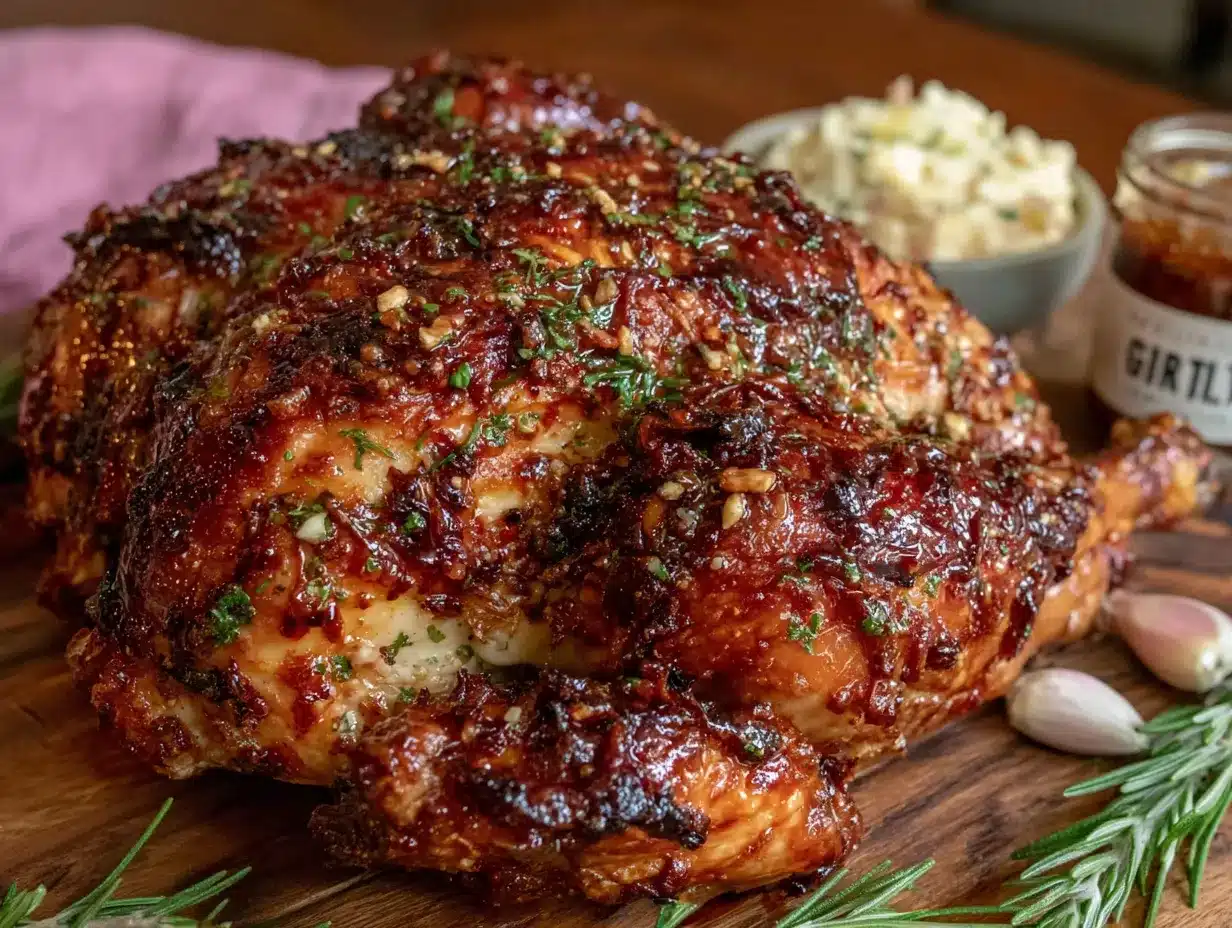
My neighbor Sarah wasn’t trying to impress anyone. I’d stopped by to borrow a ladder on a random Tuesday afternoon in November, and the smell hit me before I even got to her front door. That warm, buttery, herbaceous aroma that makes your brain stop what it’s doing and pay attention. I walked into her kitchen, and there it was—a tiny turkey, maybe eight pounds, sitting on a sheet pan looking like it belonged on a magazine cover. She was washing dishes, totally nonchalant, like she hadn’t just created something magical.
“Oh, that’s just dinner,” she said when I asked. Just dinner. Like it was nothing. But the way the garlic butter had melted into the skin, the way the herbs were crisping up around the edges—I knew I had to figure out how she did it. She shrugged and told me the basics, and honestly, I was half-listening because I was too busy staring at that beautiful bird. I left with the ladder and a new obsession.
That night, I couldn’t stop thinking about it. Not in a dramatic way, but in that quiet, nagging way where you know you’ve stumbled onto something good. Sarah’s approach was so simple, so unfussy, that I felt almost silly for never trying it myself. We’re talking a small group here, maybe four to six people, not a Thanksgiving feast for twenty. That’s the thing, right? You don’t always need a massive bird and three days of prep. Sometimes you just want a beautiful, juicy turkey without the circus. This Easy Garlic Herb Butter Roasted Turkey is that recipe. It’s the one you make when you want the flavor without the stress. Maybe you’ve been there—wanting a proper roast but dreading the whole production. This one’s for you.
Why You’ll Love This Recipe
Let me tell you why this recipe has become my go-to for small gatherings. I’ve tested it more times than I care to admit, tweaking the herb ratios, adjusting the butter temperature, figuring out the perfect roasting time. And you know what? It works every single time.
- Quick & Easy: This turkey comes together in under two hours, from prep to plate. For a weeknight dinner or a small holiday gathering, that’s a game-changer. No brining overnight, no complicated basting schedules.
- Simple Ingredients: Butter, garlic, fresh herbs, salt, pepper. That’s it. You probably have most of this in your kitchen right now. No fancy grocery trips required.
- Perfect for Small Gatherings: This is ideal for four to six people. Whether it’s Thanksgiving for a small family, a Sunday dinner, or just because you wanted roast turkey on a random Tuesday (I’ve been there), this size works beautifully.
- Crowd-Pleaser: I’ve served this to picky eaters, turkey skeptics, and people who claim they don’t like white meat. Everyone goes back for seconds. The garlic herb butter keeps every bite moist and flavorful.
- Unbelievably Delicious: The skin gets perfectly crispy, the meat stays juicy, and the flavor from the herb butter seeps into every bite. It’s comfort food at its finest, without the hassle.
What makes this recipe different from the rest? It’s the technique. Instead of fussing with complicated brines or injections, we’re using a simple compound butter that does all the heavy lifting. The butter melts into the meat as it roasts, keeping everything moist while the garlic and herbs infuse every bite. It’s not just another turkey recipe—it’s the one that makes you wonder why you ever made it any other way.
Honestly, this recipe is the kind that makes you close your eyes after the first bite. It’s comfort food reimagined—simpler, faster, but with the same soul-soothing satisfaction. Perfect for impressing guests without stress, or turning a simple meal into something memorable. You deserve a turkey dinner that doesn’t require a three-day commitment.
What Ingredients You Will Need
This recipe uses simple, wholesome ingredients to deliver bold flavor and satisfying texture without the fuss. Most of these are pantry staples, and the fresh herbs are easy to find at any grocery store.
- Turkey (6-8 pounds): Look for a small whole turkey or a large turkey breast. I prefer a whole bird for the best flavor, but a bone-in breast works great too. Make sure it’s fully thawed if frozen. (I recommend checking your local butcher for smaller birds—they’re easier to find than you’d think.)
- Unsalted butter (1/2 cup, softened): This is the base of our herb butter. Using unsalted butter lets you control the salt level. Let it sit at room temperature for about 30 minutes before mixing.
- Garlic (6 cloves, minced): Fresh garlic is non-negotiable here. Don’t use the pre-minced stuff in a jar—it won’t give you the same punch. I like to mince mine finely so it distributes evenly through the butter.
- Fresh rosemary (2 tablespoons, chopped): Rosemary and turkey are a classic pair. The piney, aromatic flavor cuts through the richness of the meat beautifully. Strip the leaves from the woody stems before chopping.
- Fresh thyme (1 tablespoon, leaves only): Thyme adds a subtle earthiness that rounds out the herb profile. Run your fingers down the stems to strip the leaves easily.
- Fresh parsley (2 tablespoons, chopped): Parsley brings freshness and a mild peppery note. Flat-leaf Italian parsley is my go-to for better flavor.
- Salt (1 tablespoon, kosher): Kosher salt is best for seasoning poultry. It dissolves evenly and enhances flavor without being too salty. I use Diamond Crystal brand for its consistent texture.
- Black pepper (1 teaspoon, freshly ground): Freshly ground pepper makes a difference. Pre-ground pepper just doesn’t have the same aromatic kick.
- Olive oil (1 tablespoon): A little olive oil helps the skin crisp up beautifully. You can skip it if you want, but I find it gives the skin that gorgeous golden color.
- Chicken or turkey broth (1 cup): This goes in the bottom of the pan to create steam and keep the turkey moist. It also makes a fantastic base for gravy later.
Substitution Guidance: If you don’t have fresh herbs, you can use dried—just use half the amount. Dried rosemary and thyme work well in a pinch. For a dairy-free option, use vegan butter or coconut oil mixed with the herbs. And if you can’t find a small turkey, a 4-5 pound bone-in turkey breast is a perfect alternative. Just adjust the cooking time slightly.
Equipment Needed
You don’t need a fancy kitchen to make this turkey work. Here’s what you’ll need:
- Roasting pan or rimmed baking sheet: A standard roasting pan is ideal, but a rimmed baking sheet works perfectly for a small bird. I’ve used both, and honestly, the baking sheet gives better air circulation for crispy skin.
- Instant-read thermometer: This is non-negotiable. Trust me, I’ve ruined enough turkeys by guessing. A good thermometer takes the stress out of roasting. I use a ThermoPro digital one that costs about $15.
- Small mixing bowl: For combining the herb butter ingredients. Any small bowl works.
- Chef’s knife and cutting board: For mincing garlic and chopping herbs. A sharp knife makes everything easier.
- Kitchen twine: Optional, but helpful for tying the legs together for even cooking. If you don’t have it, no big deal.
- Basting brush or spoon: For brushing the herb butter under the skin. A spoon works in a pinch.
- Aluminum foil: For tenting the turkey if the skin browns too quickly. You probably already have this in your drawer.
I’ve made this recipe with just a baking sheet, a knife, and a thermometer. Don’t let missing equipment stop you. If you don’t have a roasting rack, you can use crumpled foil to lift the turkey off the pan bottom.
Preparation Method
Let’s get cooking. I’ve broken this down into clear steps, and I’ll tell you exactly what to look for at each stage.
- Preheat your oven to 425°F (220°C). Get it nice and hot—this initial high heat will help the skin start crisping right away. Position the rack in the lower third of the oven so the turkey cooks evenly.
- Make the herb butter. In a small bowl, combine the softened butter, minced garlic, chopped rosemary, thyme, parsley, 1 teaspoon of salt, and 1/2 teaspoon of black pepper. Mix everything together with a fork until it’s well combined. The butter should be soft and spreadable—if it’s too firm, let it sit at room temperature for another 10 minutes. Taste a tiny bit (it’s safe, it’s just butter and herbs) and adjust seasoning if needed.
- Prepare the turkey. Remove the turkey from its packaging and take out the giblets and neck from the cavity. Pat the turkey completely dry with paper towels—this is crucial for crispy skin. Don’t skip this step. Place the turkey on your roasting pan or baking sheet, breast side up.
- Season the cavity. Sprinkle the inside of the turkey with a little salt and pepper. You can add a few sprigs of fresh herbs or a halved lemon if you like, but it’s optional. I usually add a couple of thyme sprigs for extra aroma.
- Apply the herb butter. Here’s the trick: gently loosen the skin over the breast meat by sliding your fingers between the skin and the meat. Be careful not to tear the skin. Take about two-thirds of the herb butter and spread it directly onto the breast meat under the skin. Use your fingers to massage it evenly. Then spread the remaining butter all over the outside of the turkey, getting every nook and cranny. Don’t forget the legs and wings.
- Season the outside. Sprinkle the remaining salt and pepper over the entire surface of the turkey. Drizzle with the olive oil and rub it in gently. This extra layer of fat helps the skin get gorgeously golden.
- Add broth to the pan. Pour the cup of broth into the bottom of the roasting pan, being careful not to wash the seasoning off the turkey. The broth creates steam that keeps the meat moist as it roasts.
- Roast at high heat. Place the turkey in the preheated oven and roast at 425°F for 20 minutes. This initial blast of heat starts crisping the skin. Don’t open the oven during this time—let that heat work its magic.
- Reduce the temperature. After 20 minutes, reduce the oven temperature to 350°F (175°C). Continue roasting for about 45-60 minutes, depending on the size of your bird. The general rule is about 13-15 minutes per pound at this temperature, but always rely on your thermometer, not the clock.
- Check for doneness. Start checking the temperature about 30 minutes into the reduced-heat phase. Insert your instant-read thermometer into the thickest part of the thigh, avoiding the bone. You’re looking for 165°F (74°C). The breast meat should also reach 165°F. If the skin is browning too quickly, tent the turkey loosely with aluminum foil.
- Rest the turkey. Once the turkey hits 165°F, remove it from the oven. Transfer it to a cutting board and let it rest for at least 15-20 minutes. This is not optional—resting allows the juices to redistribute throughout the meat. If you cut into it too soon, all those beautiful juices will run out onto the board instead of staying in the meat.
- Carve and serve. After resting, carve the turkey and serve with the pan juices. The meat should be incredibly moist, with crispy, flavorful skin. You’ll know you did it right when everyone at the table goes quiet for a minute.
Cooking Tips & Techniques
I’ve made this turkey more times than I can count, and I’ve learned a few things along the way. Here are the tips that make the difference between a good turkey and a great one.
Pat it dry. I cannot stress this enough. Moisture is the enemy of crispy skin. Take your time with the paper towels and get every surface as dry as possible. I once skipped this step because I was in a hurry, and the skin came out soggy and pale. Never again.
Let the butter soften properly. Cold butter won’t spread evenly under the skin. Leave it out for 30-45 minutes before you start. If you forget, you can microwave it in 5-second bursts, but be careful not to melt it—you want it soft, not liquid.
Don’t skip the resting time. I know, you’re hungry, and the turkey smells amazing. But cutting into it too soon is the number one mistake people make. That 15-20 minute rest is when the magic happens. The juices settle back into the meat fibers, making every bite tender and moist.
Use a thermometer, not a timer. Ovens vary, turkey sizes vary, and guessing just doesn’t work. An instant-read thermometer takes all the guesswork out. It’s a $15 investment that will save you from dry turkey forever.
Multitask wisely. While the turkey is roasting, you can prep your sides. Mashed potatoes, roasted vegetables, or a simple salad all come together easily. The turkey needs about 15 minutes of active prep time, then it’s hands-off for the rest. Use that time wisely.
Don’t open the oven door constantly. Every time you open the door, heat escapes, and your cooking time extends. Trust the process and only check when you need to take a temperature reading.
If the skin browns too fast, tent it. This happens sometimes, especially with smaller birds. Just lay a piece of foil loosely over the top, and it will protect the skin while the meat finishes cooking.
Variations & Adaptations
This recipe is wonderfully flexible. Here are some ways to make it your own.
Herb variations: Not a fan of rosemary? Swap it for sage or tarragon. Both work beautifully with turkey. I once made this with a mix of sage and thyme for a more traditional Thanksgiving flavor, and it was fantastic. You can also use herbes de Provence if you want a French twist.
Citrus twist: Add the zest of one lemon or orange to the herb butter. The citrus brightens up the rich flavors and adds a lovely freshness. I tried this on a whim one Sunday, and now it’s my go-to for spring dinners.
Spice it up: If you like a little heat, add 1/2 teaspoon of red pepper flakes or smoked paprika to the herb butter. The smokiness from the paprika pairs surprisingly well with the garlic and herbs.
Dairy-free version: Use vegan butter or a good quality olive oil mixed with the herbs. The texture will be slightly different, but the flavor is still incredible. I’ve made this for friends with dairy allergies, and they couldn’t tell the difference.
Smaller portions: If you’re cooking for just one or two people, use a turkey breast instead of a whole bird. A 2-3 pound bone-in breast will roast in about 45-60 minutes at 350°F after the initial high-heat blast. Same herb butter, same technique, just less time.
Make it a complete meal: Add quartered onions, carrots, and celery to the bottom of the roasting pan before you add the broth. They’ll cook in the turkey drippings and become a delicious side dish. Plus, they make the gravy even better.
Serving & Storage Suggestions
This turkey is best served hot, right after resting. The skin should be crispy, the meat juicy, and the aroma should fill the room.
Serving temperature: Serve the turkey warm, not piping hot. Letting it rest brings it to the perfect serving temperature. Carve it at the table for a beautiful presentation.
What to serve with it: This turkey pairs beautifully with mashed potatoes, roasted vegetables, a simple green salad, or stuffing. The pan juices make an excellent quick gravy—just whisk in a little flour or cornstarch and simmer until thickened. For drinks, a crisp white wine like Sauvignon Blanc or a light Pinot Noir works wonderfully.
Storage: Leftover turkey can be stored in an airtight container in the refrigerator for up to 4 days. Remove the meat from the bones before storing for easier use. The bones can be saved for making stock—just freeze them until you have enough.
Reheating: To reheat without drying out the meat, place slices in a baking dish with a splash of broth or water, cover with foil, and warm in a 300°F oven for about 10-15 minutes. You can also reheat in the microwave, but the texture won’t be as good. For crispy skin, reheat in a hot skillet with a little butter for a minute or two per side.
Freezing: Cooked turkey freezes well for up to 3 months. Wrap slices tightly in plastic wrap and then foil, or use a freezer-safe bag. Thaw in the refrigerator overnight before reheating. The flavors actually develop a bit more after freezing, so leftovers can taste even better the second time around.
Flavor development: The herb butter flavor intensifies overnight. Leftover turkey makes amazing sandwiches, salads, or soups. I love making a turkey salad with leftover meat, some mayo, chopped celery, and a little fresh parsley. It’s almost worth making extra on purpose.
Nutritional Information & Benefits
Turkey is a lean, protein-rich meat that’s packed with nutrients. Here’s a rough estimate per serving (based on 6 servings):
| Nutrient | Amount per Serving |
|---|---|
| Calories | ~350 |
| Protein | 35g |
| Fat | 22g |
| Carbohydrates | 2g |
| Fiber | 0g |
| Sugar | 0g |
| Sodium | ~600mg |
Health benefits: Turkey is an excellent source of lean protein, which supports muscle health and keeps you feeling full. It’s also rich in B vitamins, particularly B6 and B12, which are important for energy metabolism. The garlic in this recipe is known for its immune-boosting properties, and fresh herbs like rosemary and thyme are packed with antioxidants.
Dietary considerations: This recipe is naturally gluten-free, low-carb, and keto-friendly. If you’re watching your sodium, you can reduce the salt to 1 teaspoon. For a lower-fat option, use less butter and focus on getting the herb flavor from the herbs themselves. Always check with your guests about potential allergies—turkey is generally safe, but some people have sensitivities to poultry or garlic.
My perspective: I love that this recipe feels indulgent but is actually quite balanced. It’s real food made with real ingredients. No weird additives, no processed shortcuts. Just good, honest cooking that happens to be good for you too.
Conclusion
This Easy Garlic Herb Butter Roasted Turkey has become my secret weapon for small gatherings. It’s the recipe I turn to when I want to make something special without spending all day in the kitchen. The first time I made it after watching Sarah that afternoon, I couldn’t believe how simple it was. And the result? Absolutely stunning.
I love that this recipe respects your time. It doesn’t ask for complicated techniques or obscure ingredients. It just asks for good butter, fresh herbs, and a little patience while it roasts. The payoff is a turkey that looks like you spent hours fussing, when really, you just let the ingredients do the work.
My favorite part? The way the kitchen smells while it’s cooking. That buttery, herby aroma that first pulled me into Sarah’s kitchen. Now it fills my own home, and it never gets old.
I’d love to hear how this recipe works for you. Did you try any variations? What did you serve with it? Drop a comment below and let me know. And if you share a photo on social media, tag me—I love seeing your creations. Happy roasting, friends. You’ve got this.
Frequently Asked Questions
Can I use dried herbs instead of fresh?
Yes, you can. Use half the amount of dried herbs compared to fresh. So instead of 2 tablespoons of fresh rosemary, use 1 tablespoon of dried. The flavor won’t be quite as bright, but it will still be delicious.
How do I know when the turkey is fully cooked?
The only reliable way is to use an instant-read thermometer. Insert it into the thickest part of the thigh, avoiding the bone. You’re looking for 165°F (74°C). The breast meat should also reach 165°F. Don’t rely on color or time alone.
Can I prepare the herb butter ahead of time?
Absolutely. You can make the herb butter up to 3 days in advance and keep it in the refrigerator. Just let it come to room temperature before using so it spreads easily. You can also freeze it for up to 3 months—just wrap it tightly in plastic wrap.
What if my turkey is larger than 8 pounds?
This recipe is designed for small birds, but you can scale it up. For a larger turkey, increase the herb butter by 50% and add more roasting time. Plan for about 13-15 minutes per pound at 350°F after the initial high-heat blast. Always use a thermometer to check doneness.
Can I make gravy from the pan drippings?
Yes, and you absolutely should. After removing the turkey from the pan, place the pan on the stovetop over medium heat. Whisk in 2 tablespoons of flour or cornstarch and cook for 1 minute. Slowly whisk in 1-2 cups of broth or water, scraping up the browned bits from the bottom. Simmer until thickened, then season with salt and pepper. It’s the best part of the meal.
Pin This Recipe!
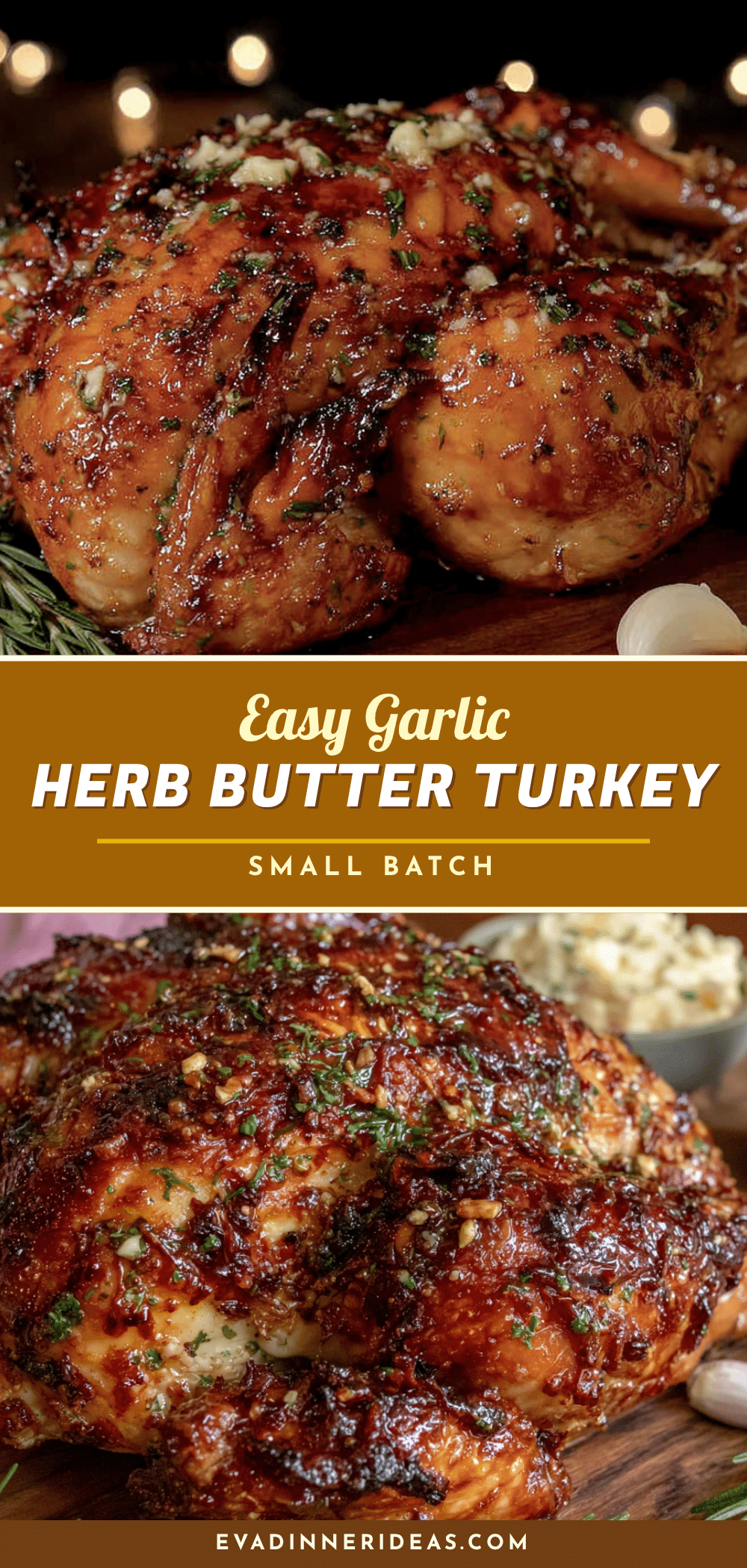
Easy Garlic Herb Butter Roasted Turkey: Perfect Small Batch

A simple, unfussy roasted turkey for small gatherings (4-6 people) that delivers crispy skin and juicy meat with a flavorful garlic herb butter. No brining or complicated techniques required.
- Prep Time: 15 minutes
- Cook Time: 1 hour 5 minutes to 1 hour 20 minutes
- Total Time: 1 hour 20 minutes to 1 hour 35 minutes
- Yield: 6 servings 1x
- Category: Main Course
- Cuisine: American
Ingredients
- 1 (6-8 pound) whole turkey, thawed if frozen
- 1/2 cup unsalted butter, softened
- 6 cloves garlic, minced
- 2 tablespoons fresh rosemary, chopped
- 1 tablespoon fresh thyme leaves
- 2 tablespoons fresh parsley, chopped
- 1 tablespoon kosher salt
- 1 teaspoon freshly ground black pepper
- 1 tablespoon olive oil
- 1 cup chicken or turkey broth
Instructions
- Preheat your oven to 425°F (220°C). Position the rack in the lower third of the oven.
- Make the herb butter: In a small bowl, combine the softened butter, minced garlic, chopped rosemary, thyme, parsley, 1 teaspoon of salt, and 1/2 teaspoon of black pepper. Mix with a fork until well combined.
- Prepare the turkey: Remove the turkey from packaging and take out the giblets and neck. Pat the turkey completely dry with paper towels. Place it on a roasting pan or rimmed baking sheet, breast side up.
- Season the cavity: Sprinkle the inside of the turkey with a little salt and pepper. Optionally, add a few sprigs of fresh herbs or a halved lemon.
- Apply the herb butter: Gently loosen the skin over the breast meat by sliding your fingers between the skin and the meat. Spread about two-thirds of the herb butter directly onto the breast meat under the skin. Spread the remaining butter all over the outside of the turkey, including the legs and wings.
- Season the outside: Sprinkle the remaining salt and pepper over the entire surface. Drizzle with olive oil and rub it in gently.
- Add broth to the pan: Pour the cup of broth into the bottom of the roasting pan, being careful not to wash off the seasoning.
- Roast at high heat: Place the turkey in the preheated oven and roast at 425°F for 20 minutes. Do not open the oven during this time.
- Reduce the temperature: After 20 minutes, reduce the oven temperature to 350°F (175°C). Continue roasting for about 45-60 minutes, or until the thickest part of the thigh reaches 165°F (74°C) on an instant-read thermometer. If the skin browns too quickly, tent loosely with aluminum foil.
- Rest the turkey: Once the turkey reaches 165°F, remove it from the oven. Transfer to a cutting board and let it rest for at least 15-20 minutes.
- Carve and serve: After resting, carve the turkey and serve with the pan juices.
Notes
Pat the turkey completely dry for crispy skin. Let the butter soften properly for easy spreading. Do not skip the resting time—it allows juices to redistribute. Use a thermometer, not a timer, for perfect doneness. If the skin browns too fast, tent with foil. The herb butter can be made up to 3 days ahead and refrigerated; bring to room temperature before using.
Nutrition
- Serving Size: 1 serving (about 6 o
- Calories: 350
- Sodium: 600
- Fat: 22
- Saturated Fat: 10
- Carbohydrates: 2
- Protein: 35
Keywords: roasted turkey, garlic herb butter, small turkey, easy turkey recipe, Thanksgiving for small group, herb butter turkey